
Technology
What is probabilistic flood forecasting?
Instead of a single yes-or-no alert, Previsico shows the likelihood and severity of flooding at each location, so teams can prioritise response rather than guess at a binary warning.
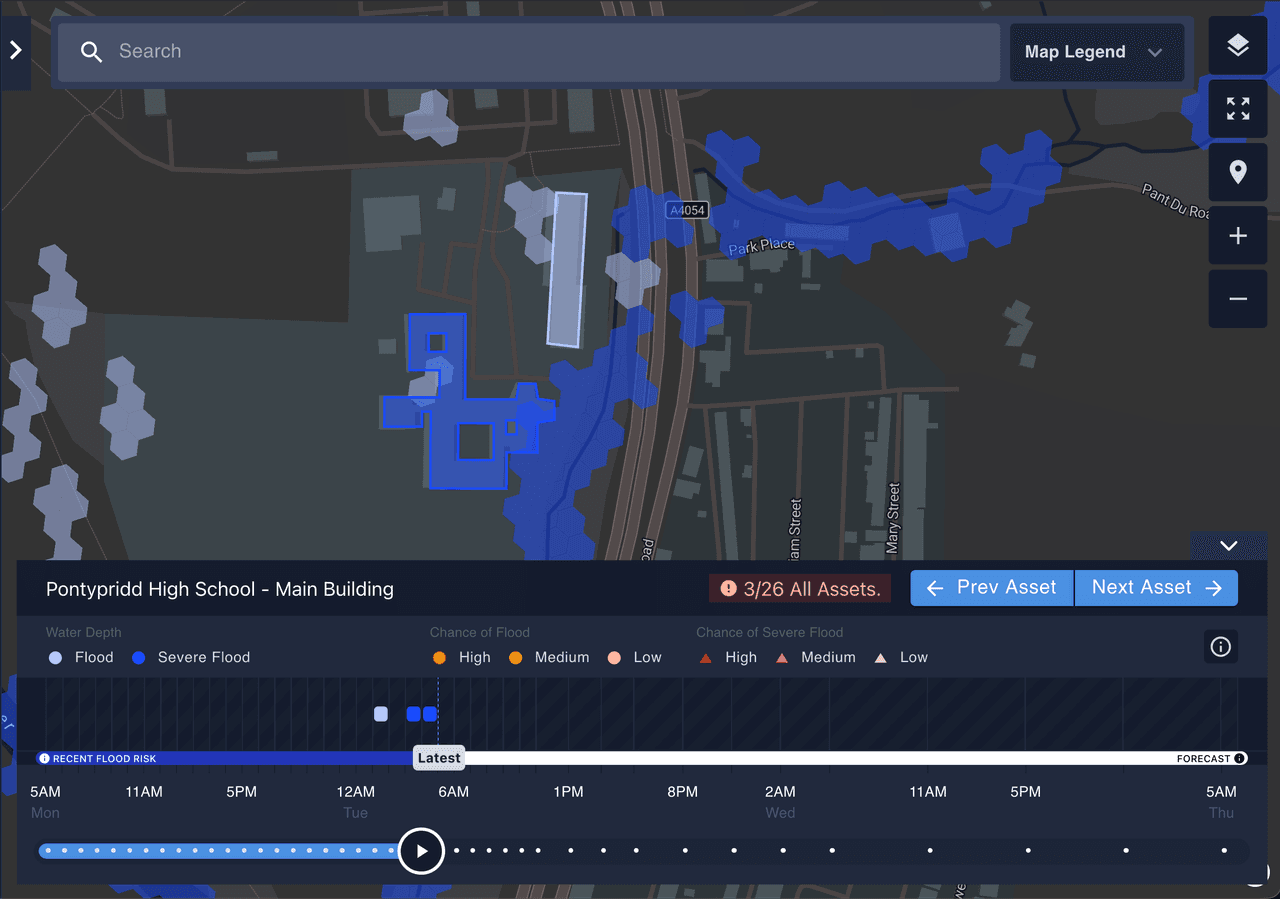
What is probabilistic flood forecasting?
Probabilistic flood forecasting shows the likelihood and severity of flooding at a specific location, rather than a single yes-or-no alert. Previsico generates hundreds of flood simulations from ensemble rainfall data every hour, producing a likelihood band (Low, Medium or High), a severity level, and an estimated depth, looking 48 hours ahead.
The four outputs
What a probabilistic forecast shows
Severity
Flood (over 5cm/2in) or Severe Flood (over 20cm/8in).
Likelihood
Low (20-40%), Medium (40-60%), or High (over 60%).
Median depth
Estimated depth across modelled scenarios, rounded to the nearest cm/inch.
Time window
A rolling 48-hour forecast, refreshed hourly as new rainfall data arrives.
Is this the same as a deterministic nowcast?
No. Academic research on regional surface water nowcasting puts the predictability limit for a precise, minute-by-minute prediction at roughly three hours. Previsico's 48-hour probabilistic forecast works at a different timescale and answers a different question: not "will this exact spot flood at this exact minute", but "how likely, how severe, and how deep, across the next two days".
Instacast, Previsico's 24-hour lookback, fills the nowcasting gap by modelling what has already happened from observed rainfall rather than a forecast.
Frequently asked questions
Probabilistic flood forecasting shows the likelihood and severity of flooding at a specific location, rather than a single yes-or-no alert. Previsico generates hundreds of flood simulations from ensemble rainfall data every hour, producing a likelihood band (Low, Medium or High), a severity level, and an estimated depth, looking 48 hours ahead.
Not exactly. A flood warning is typically a single yes-or-no signal. Previsico's probabilistic forecast instead reports a likelihood band and severity level per asset, so teams can see what's likely, what's possible, and what's unlikely, and prioritise accordingly.
No. Nowcasting is a short-range, deterministic prediction, with a predictability limit of around three hours for surface water. Probabilistic forecasting looks 48 hours ahead and reports a calibrated likelihood and severity rather than a single deterministic outcome. See Instacast for Previsico's complementary 24-hour lookback, built on observed rather than forecast rainfall.
Every hour. Weather forecasts can change quickly, so Previsico re-runs its probabilistic forecasts hourly leading up to and during a storm.
Hundreds of pre-computed flood simulations combined with ensemble rainfall data from the best available weather forecasts, run through Previsico's hydrodynamic model. See Explore the Flood Intel Platform for how forecasting, sensors and the dashboard fit together.
See probabilistic forecasting on your own sites.
Get a free flood-risk assessment and see how likelihood and severity banding works for your assets.
Related reading: Instacast: the 24-hour lookback · Explore the Flood Intel Platform · More answers