
 Lauren LegateUpdated News & insights
Smarter flood risk: key takeaways from our evening at Lloyd's
Key takeaways from Previsico's evening panel event at Lloyd's with InsTech: the changing flood risk landscape, the shift from historical data to predictive intelligence, declining rates against rising losses, and a global perspective from South Africa.
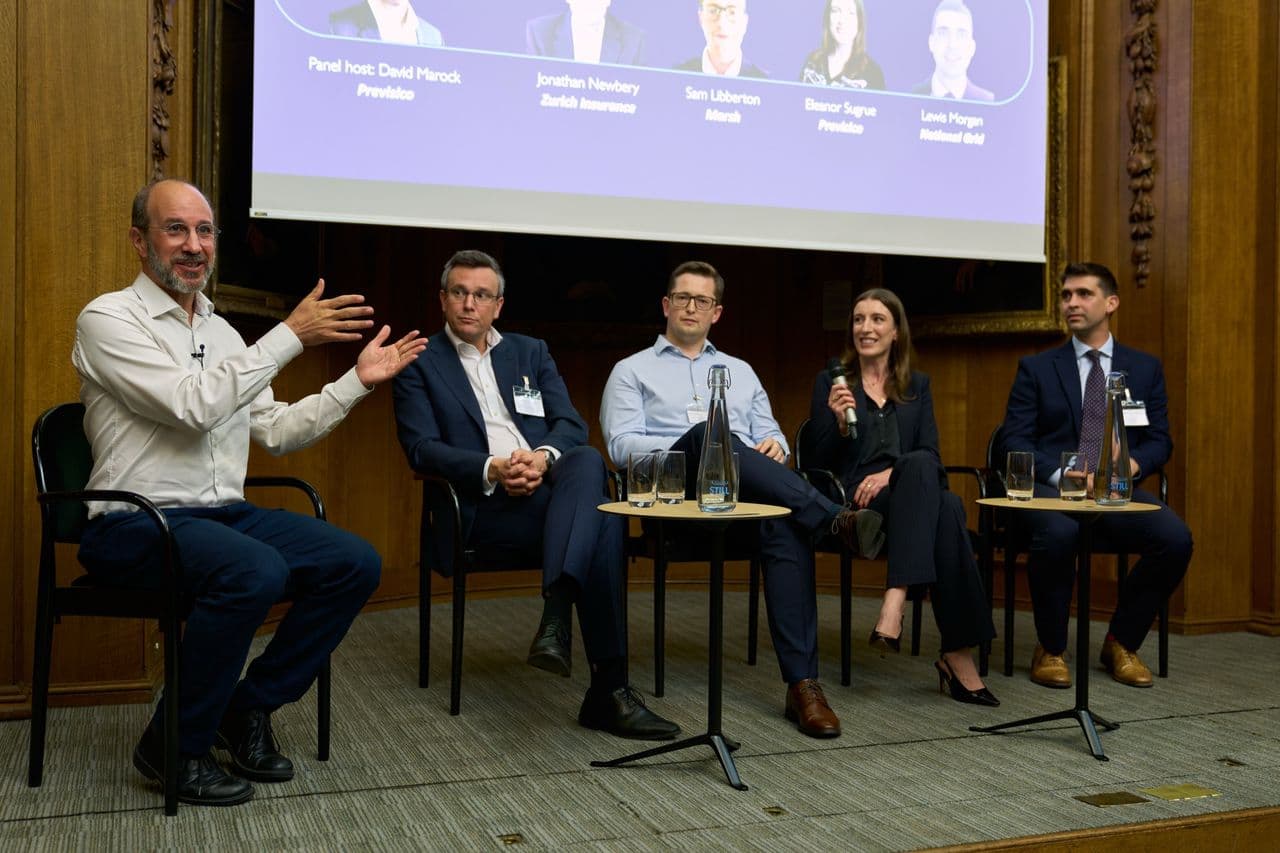
On Tuesday 29th September, Previsico hosted an in-person evening event at Lloyd’s Building in collaboration with InsTech, bringing together brokers, insurers, and risk professionals for an expert panel discussion on the evolving flood risk landscape. Here’s what was discussed.
The flood risk landscape is changing and the industry must keep pace
Flood risk is not a new concern. But as our panel made clear from the outset, the way the industry has approached it for the past two decades is increasingly unfit for purpose.
Flood events are becoming more frequent and more severe. Yet historically, underwriting attention has skewed heavily toward fire risk, with flood receiving far less focus despite its growing impact. Combined with an over-reliance on static flood maps and historical loss data, the industry has found itself ill-equipped to respond to a peril that is rapidly moving up the risk agenda.
But the good news is that the technology to do better now exists but the industry is not moving fast enough to embrace it.
From historical data to predictive intelligence
When the panel turned to what “real-time” and predictive flood intelligence actually means in practice, one theme emerged strongly: this is as much a change management challenge as it is a technological one.
For decades, the industry has built its models and processes around historical data, looking backwards to price and manage risk. Flipping that approach to predict future events in real time represents a significant shift, not just in tools but in culture and mindset.
Client awareness is moving in the right direction. Businesses are beginning to wake up to the fact that this technology exists. But insurers and brokers are still getting to grips with how to embed it meaningfully into their workflows. A key part of the challenge is reframing how clients perceive flood risk, moving away from the “it won’t happen to me” mentality that a 50-year flood horizon can create and helping them understand that flood is less a question of if but when.
Declining rates, rising losses
Perhaps the most commercially pressing discussion of the evening centred on a striking paradox in the UK market: property insurance rates have now fallen for ten consecutive quarters, yet flood losses continue to rise year on year. The ABI recently reported that adverse weather drove property insurance payouts to £6.1 billion in 2025 alone.
For insurers, the question is how to approach growing flood exposure in a softening market and whether businesses with stronger loss control and flood resilience evidence are beginning to receive differentiated treatment. The panel’s view was that this is the direction the market is heading.
For brokers, the softening market raises a deeper strategic question. When the cost of risk transfer is falling, does the broker’s role change? The consensus was clear that brokers who can bring demonstrable evidence of flood resilience to the table rather than simply securing the lowest premium, will be the ones who build stronger, more trusted client relationships.
The results are already measurable
The panel didn’t just discuss what’s possible, it showcased what’s already being done.
National Grid shared how they have been deploying sensors across their sites to build real-time situational awareness, using live data to support control room decision-making during flood events. For an organisation managing critical national infrastructure across assets with long operational lifespans, the ability to overlay flood risk data onto operational decisions in real time is already changing how they manage and respond to risk.
A comparison that resonated strongly across the panel was the parallel with cyber risk. Flood events may still occur just as cyber incidents do, but having the right intelligence and controls in place fundamentally changes the outcome. The broker, the insurer and the technology provider working together as a forward-thinking partnership is, the panel agreed, the model that delivers results.
Barriers to adoption are real
The panel was candid about the gap between what is technically possible and what is actually embedded across the industry. Changing an industry with 150 years of established practice doesn’t happen overnight. Businesses still largely lack formal flood action plans, and flood risk remains underestimated at both a corporate and SME level.
But the consensus was genuinely optimistic. The silos between insurers, brokers and technology providers are beginning to break down. High-profile flood events are forcing the issue further up the agenda. And the commercial case for smarter flood intelligence in avoided losses, better pricing accuracy and stronger client outcomes has never been clearer.
The panel was also clear that mitigation and intelligence are not an either/or. Understanding the probability of a flood event and having the right measures in place to respond are complementary, not competing. Customer engagement and feedback play a critical role in demonstrating that value, even when a flood does occur.
Looking ahead to the next five years
The panel closed on a note of cautious optimism. If data-driven flood intelligence becomes standard practice across the industry, the impact will be felt well beyond loss ratios and pricing models. It will reshape the fundamental relationship between businesses and flood risk.
The statistics that anchored the closing discussion were stark: over 50% of SMEs do not reopen following a flood event. Early warnings, action plans and resilience measures are not optional extras but are business-critical tools that the industry has both the ability and the responsibility to provide.
The panel’s collective takeaway for the room was that flood risk is underestimated, the technology to address it exists today, and what the industry needs now is advocates across insurers, brokers and businesses who are willing to make the case for change and keep flood front of mind.
A global perspective, challenges beyond the UK
The evening closed with a compelling perspective from Flip van der Merwe, Previsico’s consultant in South Africa, who brought the global dimension of flood risk into sharp focus.
Flip shared some striking statistics about the flood problem in the country. In 2022, South Africa experienced a significant flood event which resulted in R17bn (£782.6m) in infrastructure damage and unfortunately between 2022-2026 over 500 lives were lost from flash flooding, mostly in informal settlements.
Growing up in South Africa, Flip has seen what flooding does to communities and businesses that don’t get enough warning. Getting involved with Previsico and helping achieve the company’s mission, provides technology to the market at a critical time the country needs it most.
It was a powerful reminder that the mission driving Previsico’s work to reduce the impacts of flooding through actionable intelligence extends far beyond the UK. Flood risk is a global challenge, and the tools and expertise being developed here have the potential to protect lives, livelihoods and infrastructure around the world.
Final thoughts
Tuesday evening was a reminder of both the scale of the challenge ahead and the genuine momentum building across the industry to meet it. The technology exists. The commercial case is proven. The collaboration between insurers, brokers and technology providers is growing.
The question now is one of pace and the panel left little doubt that the time to act is now.
To find out more about how Previsico’s flood risk intelligence can support your business or your clients, please do get in touch.
Lauren Legate