
Previsico’s Flood Intel Platform receives its biggest innovation yet
Five major advances in accuracy, real-time intelligence, and decision support all now live and available to organisations worldwide.
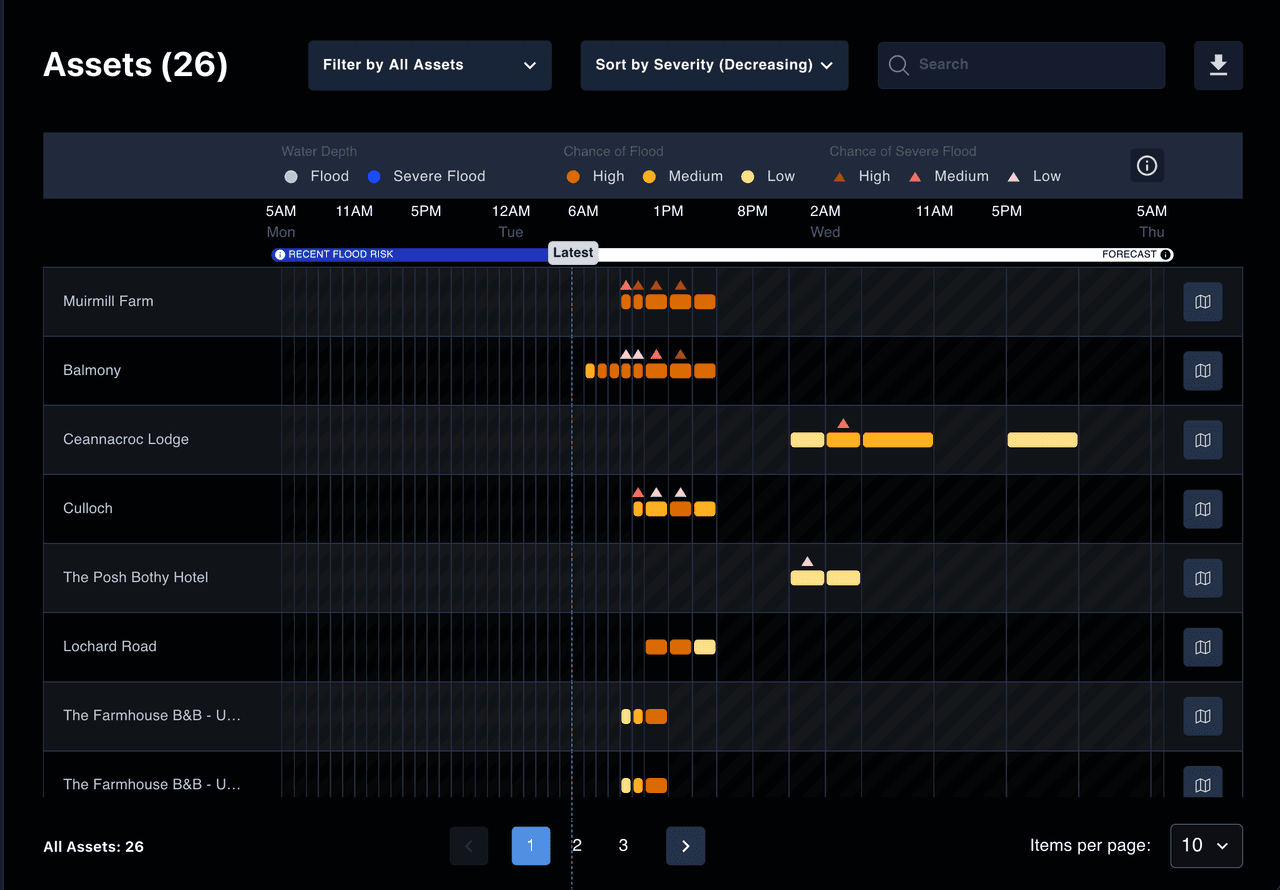
At Previsico, our mission has always been to reduce the impacts of flooding worldwide by giving people and organisations the intelligence they need to act before the water arrives. Today we are taking the single biggest step forward in that mission since we launched.
Our biggest innovation yet is now live across our service, and with it comes a genuine shift in what flood forecasting can do for the businesses, insurers and communities we serve.
This release has been years in the making. It takes on two of the hardest problems in flood science: how to communicate a complex, uncertain event without reducing it to a binary yes-or-no answer, and how to keep pace with weather that can change faster than models have traditionally been able to run. We have solved both, and gone further.
Why This Matters
Flooding is the world's most damaging and disruptive natural hazard. It affects homes, businesses, infrastructure and communities on every continent, and as climate change intensifies, both the frequency and the severity of flood events are rising.
For the people who have to make real decisions in real time, the questions are always the same. How likely is flooding at this specific location? When will the water arrive? How long will it last? Answering those questions at property-level resolution, early enough to act on, is one of the most demanding challenges in environmental science. It is the challenge we have spent more than 20 years working on, and this release represents our biggest leap forward yet.
"Instead of telling users whether flooding is expected or not, our platform now shows a far more detailed view of the outcome, including the likelihood and severity of flooding, with accurate, timely and actionable intelligence to support live response efforts." — Sam Wilks, Head of Product, Previsico
Five Major Advances
1. Probabilistic Flood Forecasts
The centrepiece of this release is the introduction of Probabilistic Flood Forecasts (PFFs). Flood forecasting across the industry has historically been deterministic. It produces a single prediction, one best estimate of what will happen. But flood events are inherently uncertain, and a single answer conceals a wide range of possible outcomes, from shallow surface water to significant inundation, with no indication of how likely any of them are but PFFs change that.
Generated from 200+ rainfall and flood scenarios using the latest available data, they provide a probabilistic view of both the likelihood and the severity of flooding at any given location. Instead of answering "will it flood?", our platform now answers "how likely is flooding, and how bad could it get?".
For anyone making decisions on flood intelligence, whether that is a risk manager deciding where to pre-position resource, an operations team deciding whether to close a site, or an insurer triaging incoming claims, that granularity changes what is possible. Decisions get made with greater confidence, and scarce resources go where they are actually needed.
2. Hourly Forecasts
Flood events move fast. A storm that looks manageable at 9am can be a major incident by noon.
Our platform now generates updated forecasts every hour. Running hydrodynamic models at property-level resolution is computationally intensive, and delivering that at scale, every hour, across whole national footprints, is a significant engineering achievement. It means that as a storm intensifies, shifts track or loses strength, the platform captures those changes and reflects them in near real-time. The intelligence driving decisions is never more than an hour old.
This is particularly valuable for fast-moving surface water flood events, which can develop and peak within a matter of hours and have long been the hardest category of flooding to predict and respond to in time.
3. 24-Hour Retrospective Analysis
Understanding what is happening now is only part of the picture. Understanding what happened in the hours before, how an event developed, where water accumulated, which locations were affected first, is equally important during an active event and essential for reviewing it afterwards.
Our retrospective analysis window now extends to a full 24 hours. Using radar rainfall data combined with our hydrodynamic modelling, the platform produces a detailed, hour-by-hour reconstruction of any flood event, so teams can see exactly how a situation evolved across every monitored location.
In practice, this supports faster post-event review, more accurate loss assessment, better validation of the warnings issued, and stronger evidence for reporting and planning. It also gives remote teams a precise account of what happened at sites they could not reach.
4. A New Platform Experience
New capability needs new ways to surface it. Our platform interface has been rebuilt around how our customers actually work, particularly during high-pressure live events when clarity matters most.
The new dashboard is designed for specialist users who work in the platform daily and non-specialists who need to act on what it is showing them without training. Alerts are clearer, risk indicators are sharper, and the layout is built to reduce cognitive load precisely when it is under the most strain.
For organisations where multiple teams, from operations and risk through to facilities and senior leadership, need to engage with flood intelligence at different levels of detail, that matters enormously.
5. High-Performance API
For many of our customers, the real value of flood intelligence lies not just in what they see on the dashboard, but in how that intelligence flows into the other systems and workflows they depend on.
Our new API is fully versioned, high-performance, and mirrors every feature available on the platform. It moves beyond fixed-format data feeds to a richer, more flexible output built for modern data workflows, making it straightforward for organisations to embed Previsico's flood intelligence directly into their own portals, risk management systems, operational dashboards and business continuity tools.
Now Available Globally
Alongside these five advances, this release marks a significant expansion of Previsico's reach. Our platform is now available globally, and is already live in the US, South Africa and Western Europe, with more markets to follow.
Flooding does not respect national borders, and the need for accurate, actionable flood intelligence is not limited to any single region or market. Organisations in developed economies face growing flood risk as climate patterns shift. Those in emerging markets often work with less developed warning infrastructure. And in developing countries, the consequences of flooding are frequently most severe, yet access to early warning capability is most limited.
Our mission is to reduce the impacts of flooding worldwide. Extending our platform internationally is a direct expression of that mission, bringing property-level flood intelligence to organisations in more of the places where it is needed.
"Flood doesn't recognise borders, and neither should flood intelligence." — Sam Wilks, Head of Product, Previsico
What This Means for You
You are no longer limited to knowing whether flooding is expected. You now know how likely it is at a specific location, when the water will arrive and how long it will last. Forecasts refresh every hour, so you are acting on what is happening rather than a picture from three hours ago. And once an event has passed, a full 24-hour reconstruction shows exactly how it unfolded across every location you monitor.
What that looks like in practice depends on where you sit. For insurers, it means earlier intervention that reduces claims frequency and severity, and faster, more accurate loss quantification. For brokers, it means offering clients a genuine risk management capability rather than a policy alone. For large asset owners, it means protecting sites, stock and people with enough lead time to act. The underlying need is the same across all three: accurate, timely, actionable intelligence, early enough to do something about it.
Previsico Team